


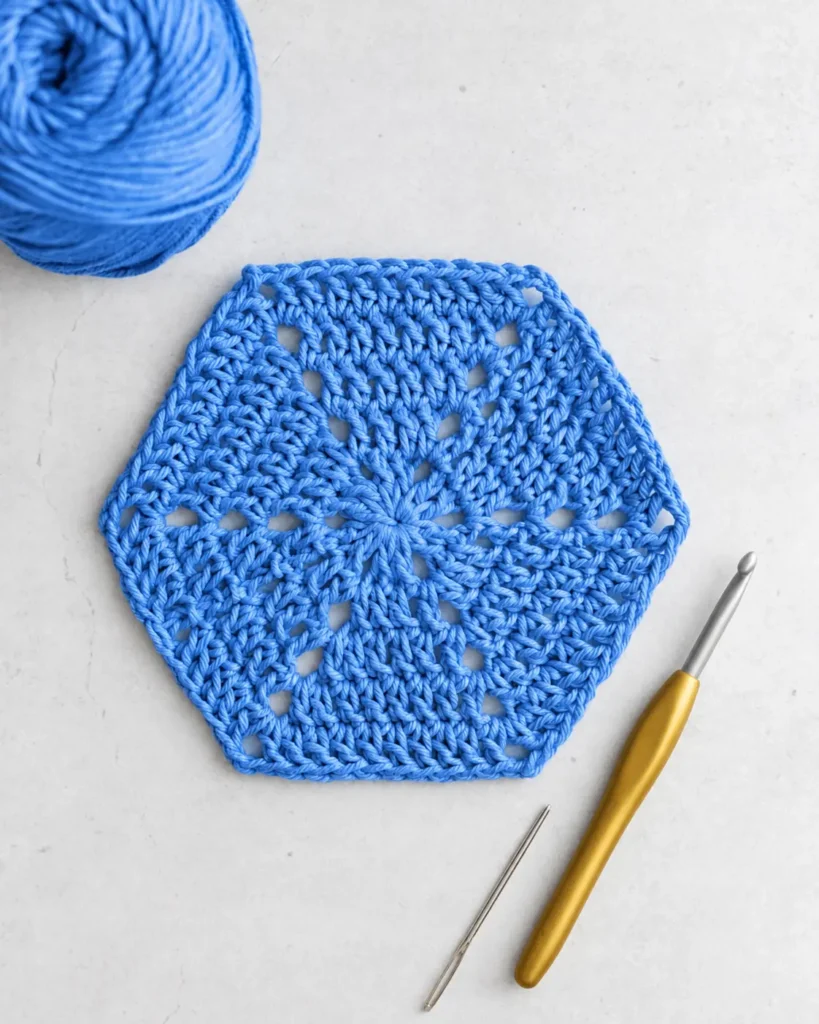
Crochet hexagons start with a small center and grow one corner at a time. This flat, six-sided motif uses US double crochet, chains, and slip stitches. The four-round pattern below gives you a count to check after every round, so you can spot a missed stitch before the shape drifts.
Make one hexagon as a practice piece, or repeat the same rounds to make motifs for a blanket or cushion. The corner spaces stay open for joining. If you are new to the basic motions, begin with our first crochet practice square and return when you can recognize the top of a stitch.
Gather your yarn and tools
Choose smooth, light-colored yarn so the stitch tops and six corner spaces are easy to see. A medium, category 4 yarn is a practical starting point; the Craft Yarn Council yarn weight guide lists this category as worsted, afghan, or aran and gives hook ranges as guidelines. Follow your yarn label for a first hook choice, then adjust for your own tension.
You will also need scissors, a blunt yarn needle, and, if you have them, six removable stitch markers. The markers can sit in the corner spaces while you learn the repeat. A ruler is useful when several motifs need to finish at the same size.
This pattern uses US terms: ch means chain, dc means double crochet, sl st means slip stitch, and sp means space. The Craft Yarn Council crochet abbreviation list also shows the US and UK name differences: a US double crochet is a UK treble crochet.
Begin with a magic ring if you want to close the center neatly. If that technique is new, chain 4 and slip stitch into the first chain to make a small ring instead. Either opening works with the same round counts below; a chain ring simply leaves a more visible center opening.
Understand the six-corner repeat
Each round has exactly six chain-2 corner spaces. Between those spaces are six equal sides. Work one double crochet in every existing double crochet along a side, then put (dc, ch 2, dc) into the next corner space; those two new double crochets add one stitch to each neighboring side. The parentheses group stitches worked into that one space, as explained in the Craft Yarn Council pattern-reading guide.
The first round is the only exception to that repeating move: it creates the six corners inside the center ring. Its starting chain 3 counts as one double crochet. In rounds 2 and later, the short chain 2 used to lift the hook at the start does not count as a stitch. These choices keep the totals consistent.
Put a marker in each chain-2 corner after round 1 if the gaps are hard to distinguish. Move each marker into the new corner space as you go. Count double crochets only when checking the side totals; the corner chains and joining slip stitch are separate.
| Completed round | Double crochets per side | Double crochets total | Chain-2 corners |
|---|---|---|---|
| 1 | 2 | 12 | 6 |
| 2 | 4 | 24 | 6 |
| 3 | 6 | 36 | 6 |
| 4 | 8 | 48 | 6 |
| 5, if continued | 10 | 60 | 6 |
The table is a quick error check rather than a target measurement. Each new round adds two double crochets to every side, or 12 stitches around the whole hexagon. The six corner spaces stay at six; making a seventh corner will change the shape.
Crochet the hexagon, round by round
Round 1: Make the center
Make a magic ring or chain-4 ring. Chain 3, which counts as your first double crochet, then make one double crochet into the ring and chain 2. Work (2 dc, ch 2) into the ring five more times. Slip stitch into the top of the starting chain 3 to close the round.
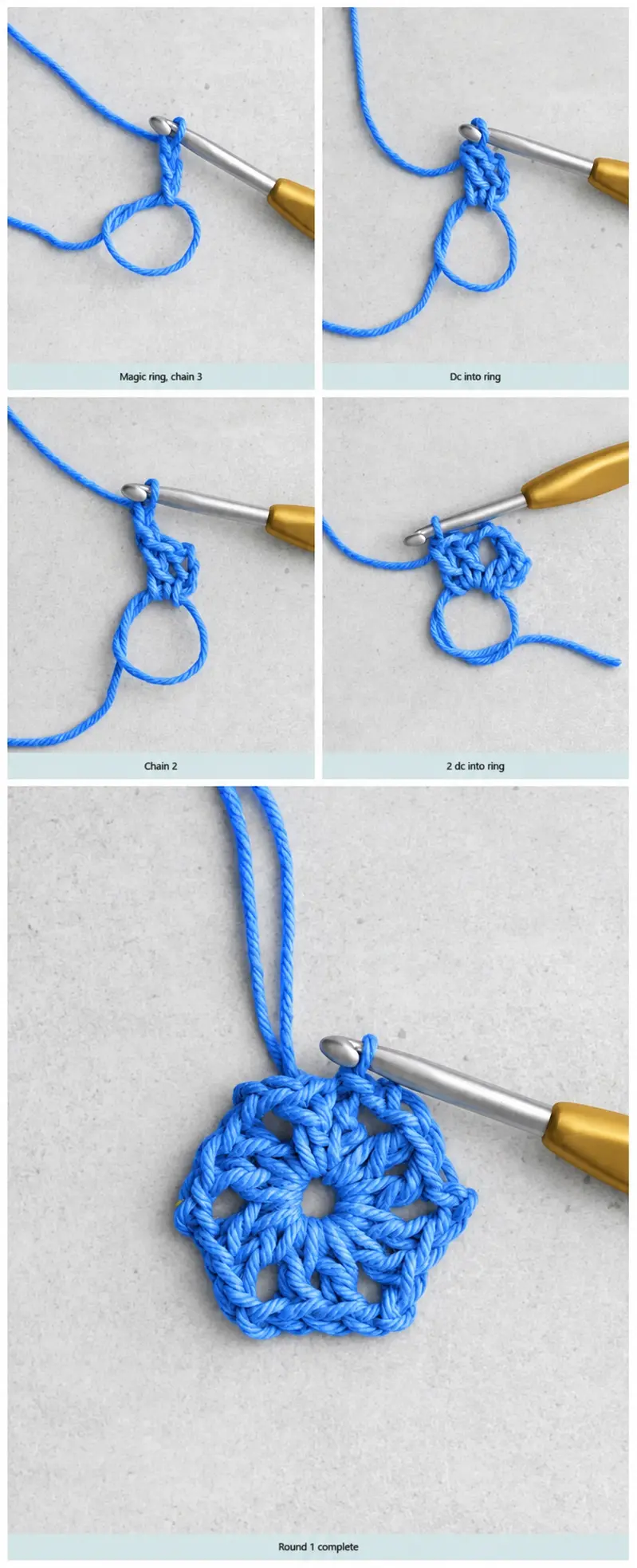
Check the small shape before continuing: it should have six groups of two double crochets and six chain-2 gaps. Count the starting chain 3 as the first stitch of the first group. Gently tighten a magic ring now, but leave enough room for the center stitches to sit comfortably.
Move the working loop to a corner
The join at the end of round 1 sits on the first stitch of a side. Slip stitch into the next double crochet and then into the following chain-2 corner space. At the start of later rounds, the join will sit beside the first corner, so one slip stitch into that corner space is enough.
Do not count either of those positioning slip stitches as a new double crochet. The chain 2 that lifts your hook at the start of each later round is also uncounted; the chain 2 inside the corner group is the actual corner space. If a seam looks crowded, identify these two different chain uses before adding stitches.
Round 2: Build six sides
From the corner space, chain 2 for height without counting it. Work (dc, ch 2, dc) into that same corner, then work one double crochet in each of the next two double crochets along the old side. Repeat that corner group and two side stitches at each of the other five corners and sides. Join with a slip stitch in the first double crochet of this round.
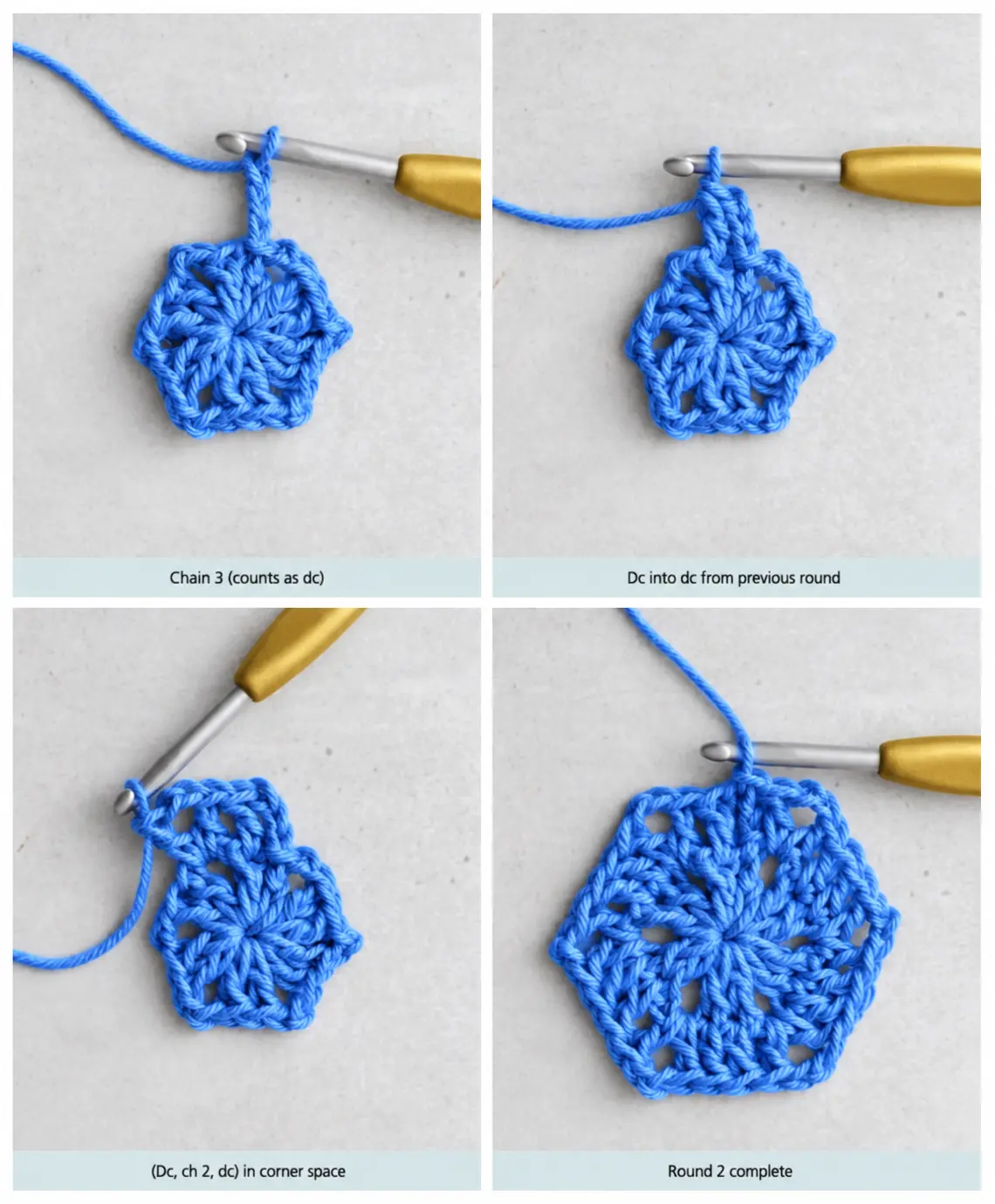
You should now have four double crochets on each side and 24 altogether, with six open corners. A side includes the double crochet immediately after one corner, the two old side stitches, and the double crochet immediately before the next corner. Counting that way makes the increase easier to see.
Round 3: Follow the same route
Slip stitch into the nearby corner space and chain 2 for height. Work (dc, ch 2, dc) in that corner, then make one double crochet in each of the four old double crochets on the following side. Continue around all six corners and sides in the same order, then slip stitch into the first double crochet to join.
Each side now has six double crochets, for 36 around the motif. If one side has only five, look first at the stitch directly after a corner; it can hide close to the corner group. Fix a missing stitch before working another round, because the next side count depends on it.
Round 4: Check the edges
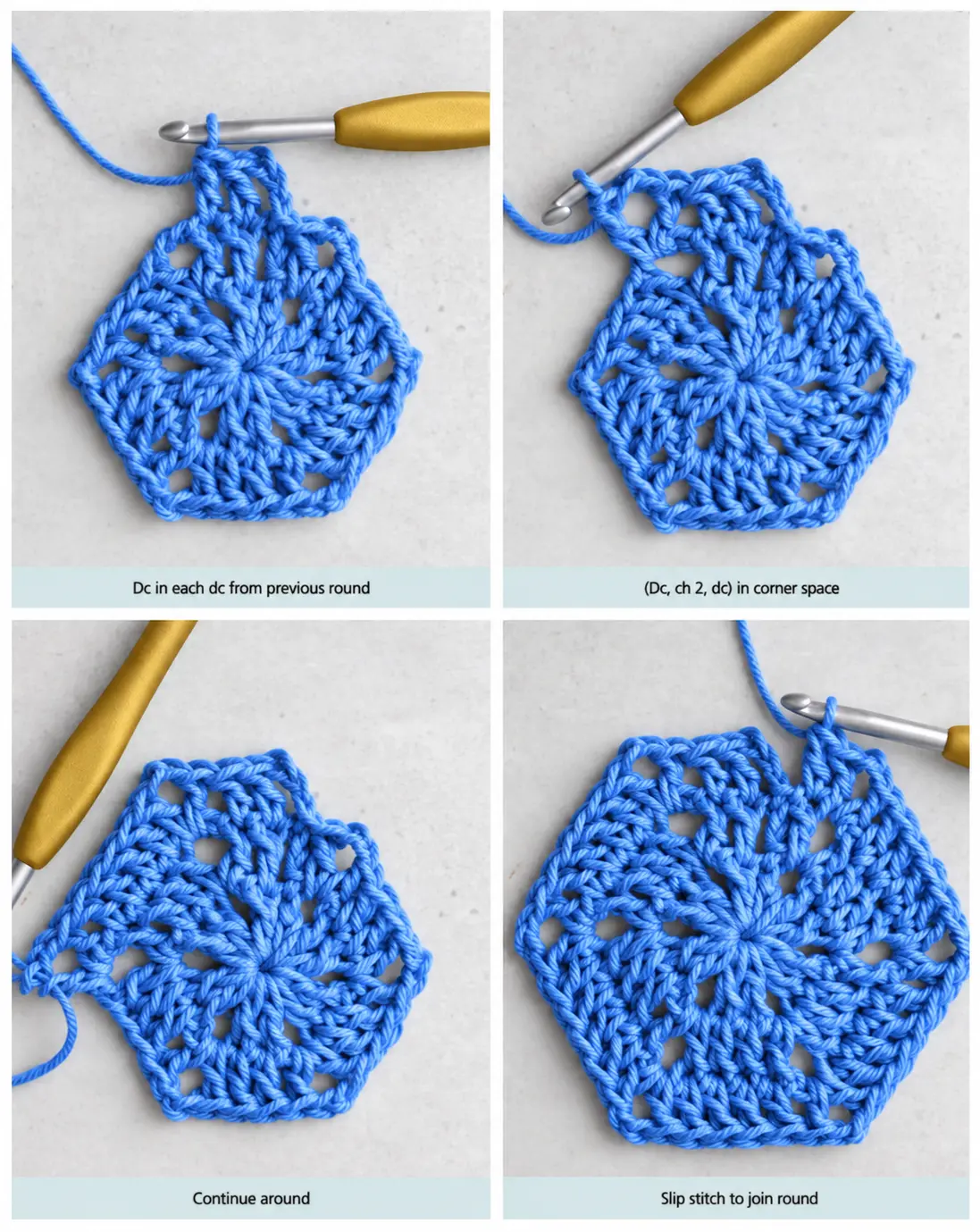
Move into the next corner space with a slip stitch and chain 2 for height. Make (dc, ch 2, dc) in the corner, then double crochet once in each of the six existing stitches along the next side. Repeat this across all six sides and join into the first double crochet of the round.
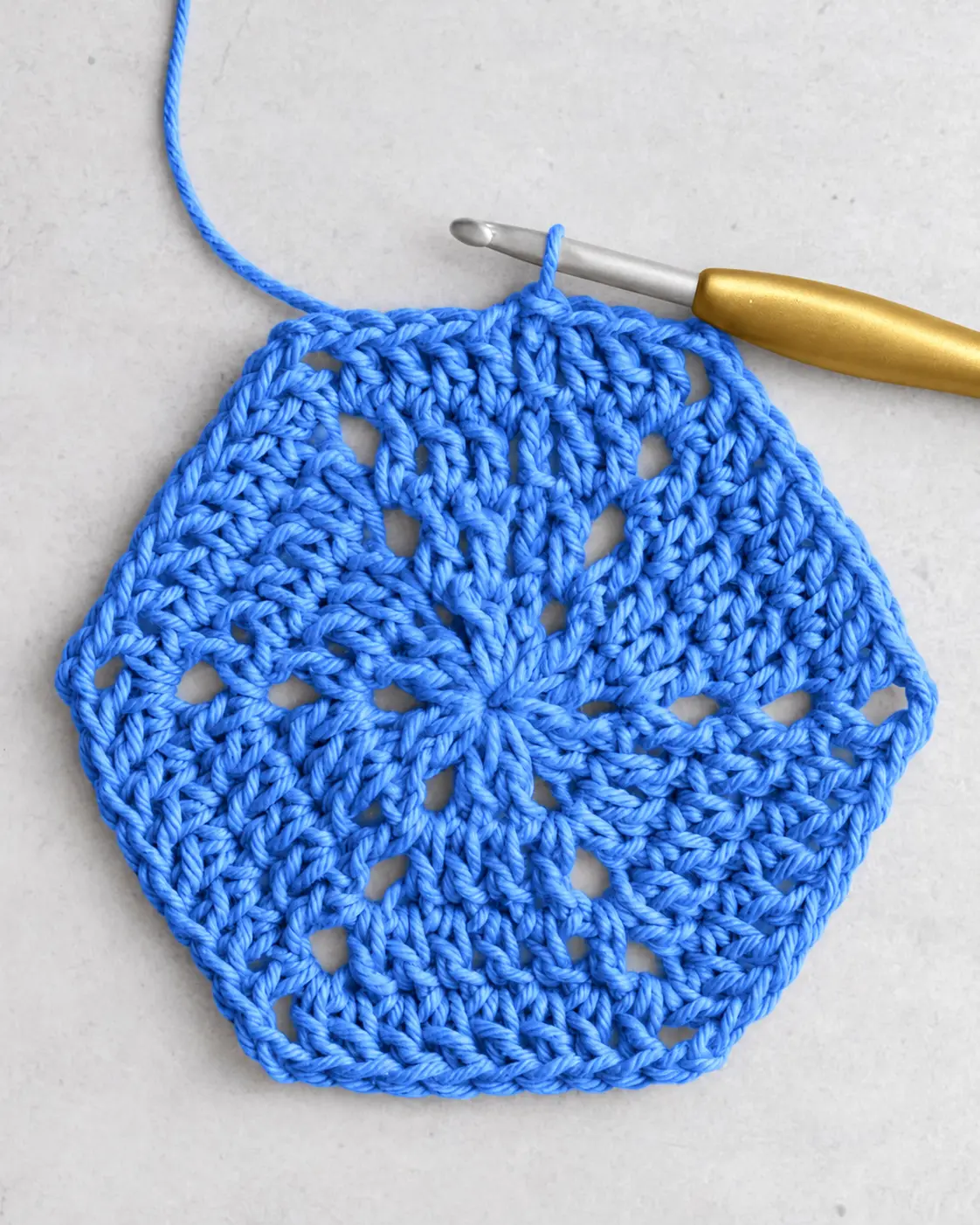
The completed fourth round has eight double crochets per side, 48 total, and six chain-2 corners. Lay the piece down and check whether its six edges look reasonably even. A slight change in edge shape can come from tension; an incorrect stitch or corner count is the first thing to rule out.
Add more rounds or finish
For round 5 and every later round, move into a corner space, chain 2 for height, make (dc, ch 2, dc) in that corner, and work one double crochet in every existing side stitch until the next corner. Continue around and join into the first double crochet. The side count rises by two each round, so round 5 has ten stitches per side and 60 total.
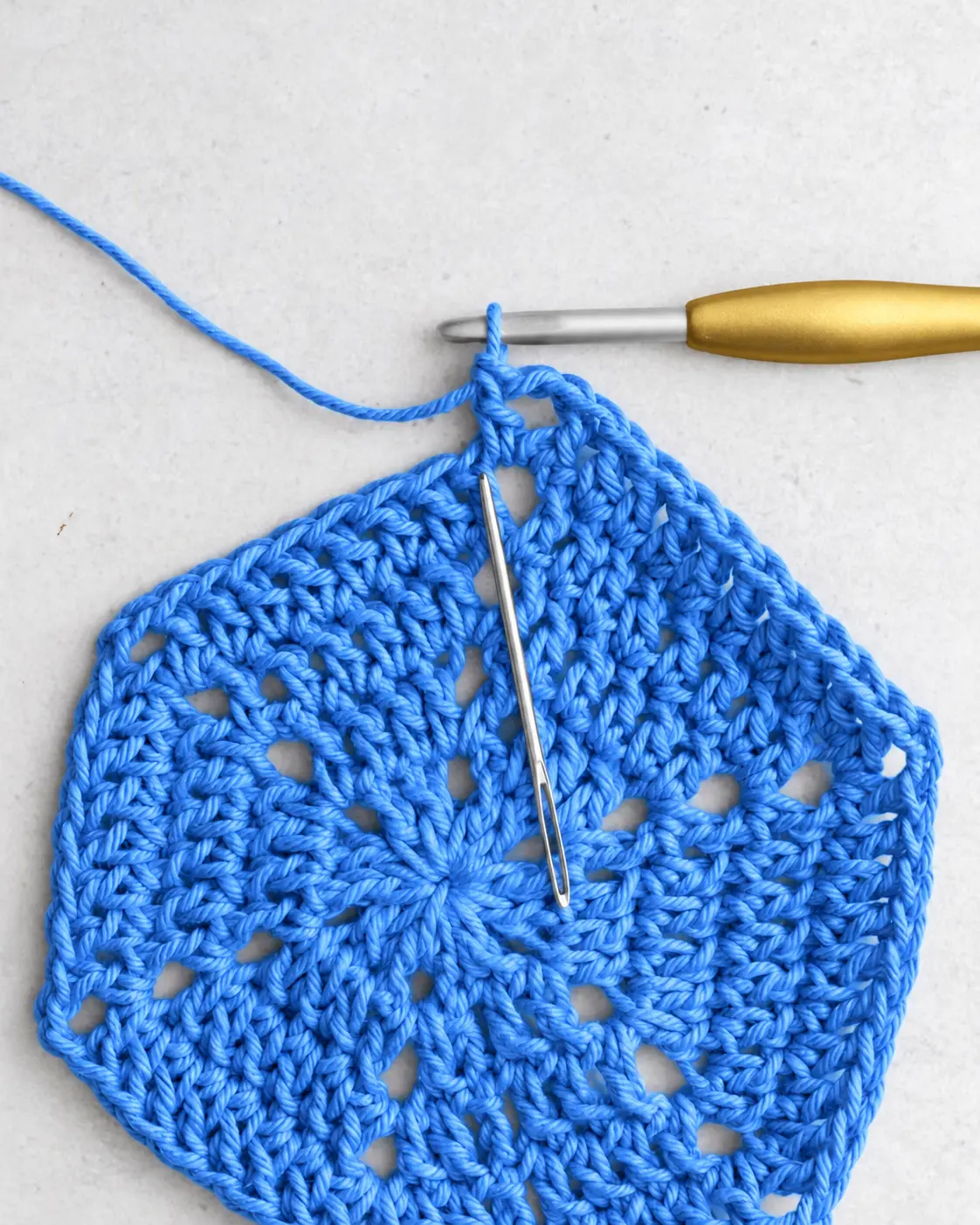
Stop when the motif suits your project. Cut the yarn with a tail long enough to weave securely, pull it through the final loop, and weave it through stitches on the back with a blunt needle. If you plan to sew motifs together, leave a longer tail for the seam.
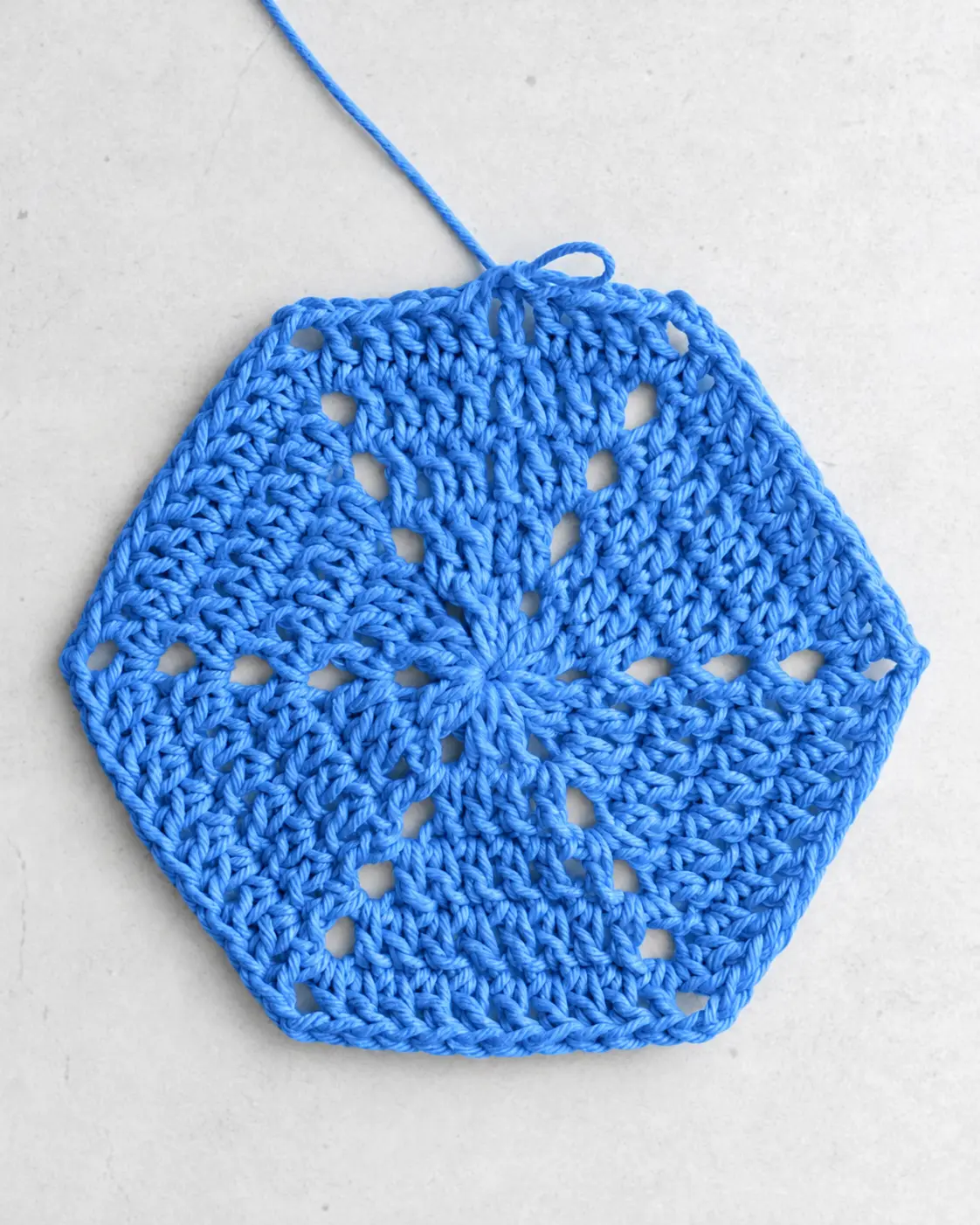
Size is not fixed by the written round count: yarn, hook, and tension all change the finished measurement. If you need several matching motifs, make one sample, measure it across opposite straight edges, and use the same yarn and hook for the rest. For a fitted item, follow that project’s own gauge and construction instructions.
Fix a shape that looks wrong
If the hexagon cups upward, count six corners and check that you made (dc, ch 2, dc) in every one. Then count the stitches on each side against the table. Tight tension can also draw the motif inward; if the counts are correct, try relaxing your grip or compare a small sample with a slightly larger hook.
If the edges ripple, check for an extra double crochet along a side or a corner worked twice. Unpick to the last round with six corners and equal side counts, then work forward from there. A larger hook will generally loosen the fabric further, so counting is the better first check for this problem.
An uneven join is often a counting issue rather than a missing corner. The round-start lifting chain 2 is not a stitch in this pattern, while the first double crochet beside it is. Join into that first double crochet, and avoid adding a double crochet into the joining slip stitch on the next pass.
A visible center hole is normal with a chain-4 ring. With a magic ring, pull the starting tail to snug the opening after round 1, then weave the tail in thoroughly so it stays closed. Avoid pulling so hard that the first six groups bunch into a raised knot.
Use and join your finished motifs
For a blanket or cushion panel, make motifs with the same round count, then place two right sides together and sew along matching side stitches, or join them with a narrow crochet seam. Keep each corner accessible so the junction between neighboring hexagons stays neat. Make a small joined sample before committing to a large layout.
This is a flat motif. A hexagon cardigan often uses a different, deliberately folding construction, so do not assume one flat motif can replace that garment pattern. For more foundation lessons and project ideas, browse the I Heart DIY Crochet tutorials.
If your first hexagon has six corners and matching side counts, you have the repeat you need. Save the table for the next motif, and measure a sample before making a batch for a larger project. The I Heart DIY About Us page explains the site’s editorial approach and how to share corrections.
Have a question? Use the form above to submit your question or comment.
I love hearing from you and seeing what you made!