

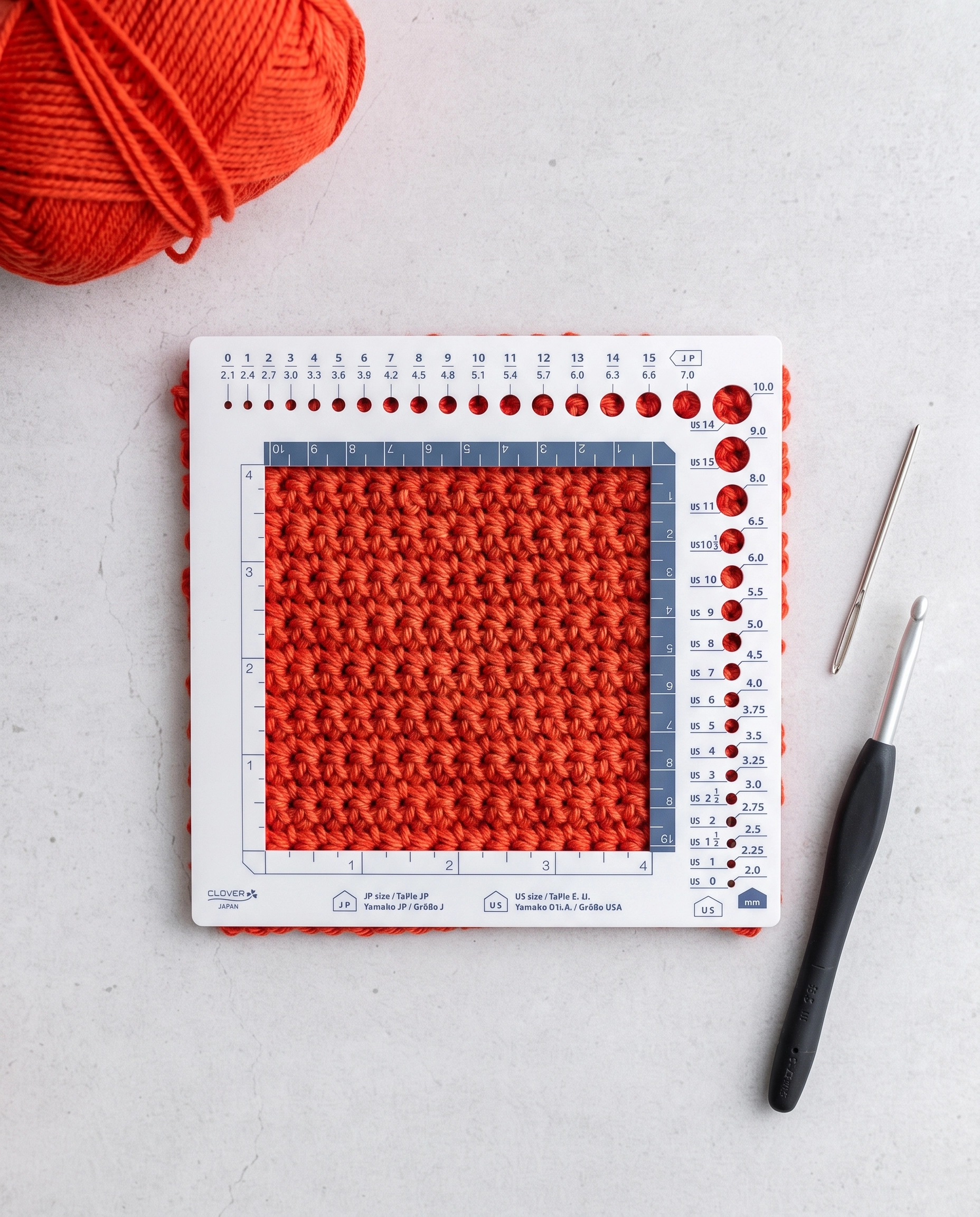
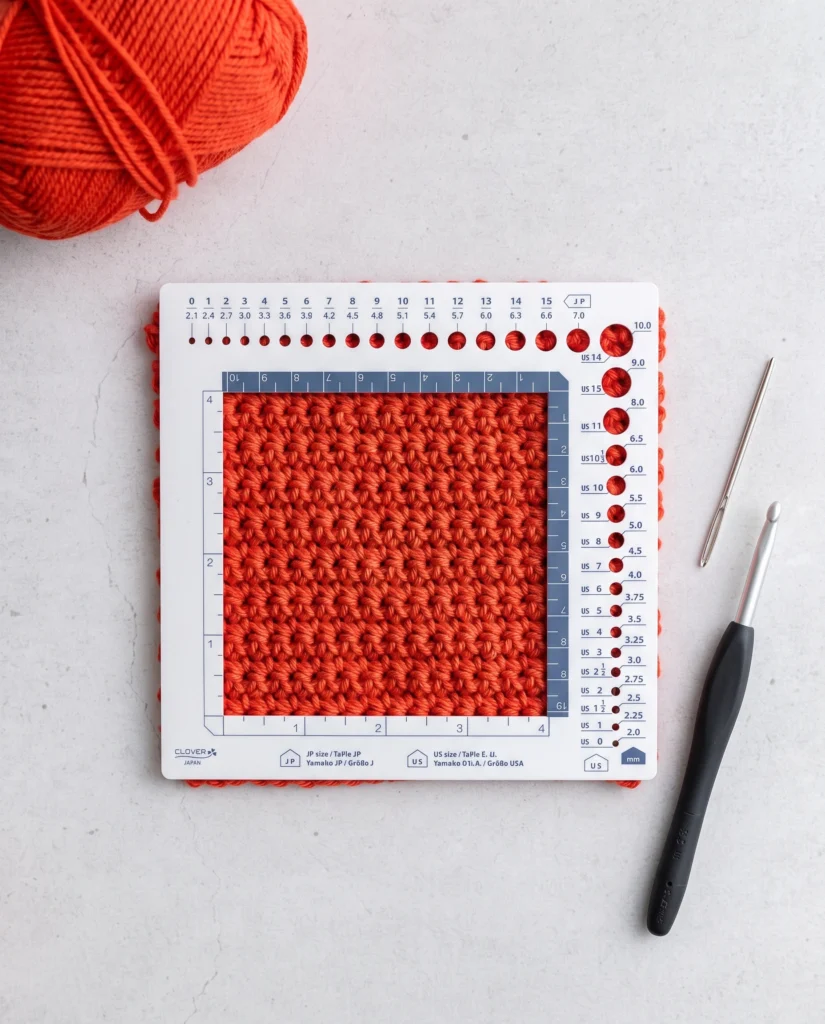
Crochet gauge tells you whether your stitches will produce the size a pattern expects. A few minutes with a small sample can save you from finishing a hat, sweater, or bag that measures differently from the instructions.
The hook size printed in a pattern is a starting point. Your yarn, hook, stitch pattern, and way of working all affect the fabric you actually make, so the swatch is the useful test.
This guide shows you how to read a gauge line, make a sample large enough to measure, count stitches and rows, and decide what to change when the numbers differ.
All stitch names here use US crochet terms. If you are following a pattern written with UK terms, translate the stitch name before making your swatch.
The short version
- Work a sample in the pattern's yarn and stitch pattern, using its suggested hook as a starting point.
- Make the sample larger than the area you need to measure, then wash or block it as the finished project will be treated.
- Count stitches across and rows up in the center. Compare each count with the pattern before changing hooks.
What crochet gauge measures
A pattern's crochet gauge describes how many stitches fit across a stated width and how many rows fit within a stated height. The Craft Yarn Council's gauge guide explains why those counts affect finished size. Many US patterns express gauge over 4 inches, sometimes paired with 10 cm; use the exact measuring distance specified by your pattern.
Stitch gauge is the horizontal count. If you fit more stitches into the measured width than the pattern calls for, each stitch is narrower and a piece made with the same stitch count will tend to be narrower.
Row gauge is the vertical count. More rows in the measured height means your rows are shorter, which can change the length of a sleeve, the depth of a hat, or the position of shaping.
For example, “16 single crochet stitches and 20 rows = 4 inches” describes a fabric with 16 stitches across and 20 rows up within separate 4-inch measurements. It does not tell you to stop your swatch at exactly 16 stitches or 20 rows.
Think of gauge as a measurement of the finished fabric rather than a test of whether you crochet “correctly.” Changing hook size is normal; the hook named by a designer may not be the one that gives you the required fabric.
How to read the gauge line in a pattern
A gauge line should tell you what to count, over what distance, and in which stitch pattern. Look for notes about whether the sample is worked flat or in rounds and whether it is measured after blocking.
The named stitch matters. A single crochet sample cannot stand in for a lace pattern made from chains and double crochets, because the spaces and repeats change the fabric's width.
Some patterns count complete repeats instead of individual stitches. If the instructions say “four shells across 4 inches,” make enough shells to measure the full repeat in the center, and count the units the designer specifies.
Motif patterns may give the size of one finished square, circle, or hexagon. Measure the motif in the same state described by the pattern; joining and blocking can change its final dimensions.

The gauge printed on a yarn label is a general guide for that yarn. When you follow a particular design, its stitch pattern and its gauge line are the measurements to match.
Why a small gauge difference matters
Check gauge when the finished dimensions matter: clothing, fitted accessories, matched motifs, or any project with limited yarn. A dishcloth can tolerate more variation, but a swatch still shows you the fabric's feel and likely size.
Here is the arithmetic behind fit. At 16 stitches per 4 inches, 48 stitches span about 12 inches; at 18 stitches per 4 inches, the same 48 stitches span about 10.7 inches. That difference of roughly 1.3 inches comes from just two extra stitches in the gauge measurement.
Width is only half the story. A row-gauge difference can shift where increases, decreases, or color changes fall, even when the stitch count across is right.



Make a swatch you can trust
Use the yarn you plan to use in the project and begin with the hook size suggested by the pattern. If you substitute yarn, swatch the substitute; two yarns in the same weight category may still make different fabric.
Make the sample larger than the area you will measure. For a 4-inch gauge, a square about 6 inches wide and tall gives you space to count away from the first and last stitches and the starting edge, as Lion Brand's swatching guide recommends.
Estimate the starting chain from the pattern's stitch gauge, then add enough stitches for the extra width and any required stitch multiple. If the pattern says 16 stitches in 4 inches, a 6-inch sample needs about 24 working stitches before you allow for the pattern repeat or turning chain.
Work the stitch pattern the project actually uses, keeping your usual comfortable tension. If the project is worked in rounds and the pattern asks for a round swatch, follow that instruction rather than assuming flat rows will behave the same way.
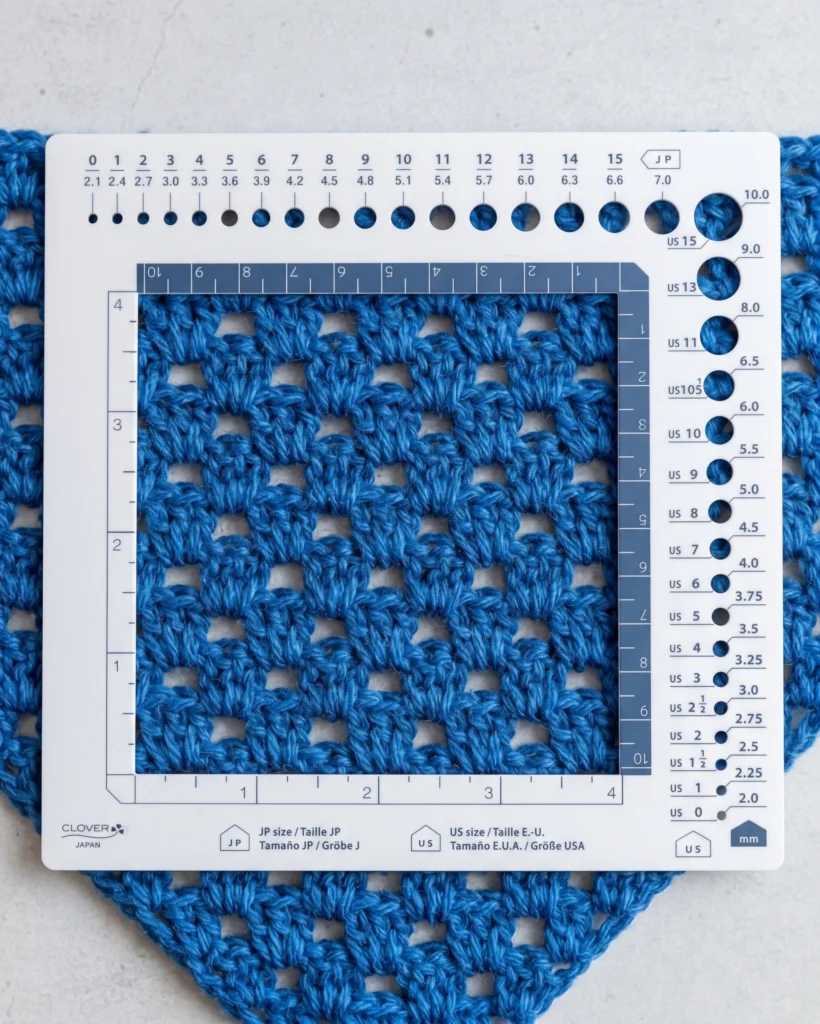
Treat the sample as you will treat the completed piece. Wash it if the project will be washed, block it if the pattern calls for blocking, and let it dry fully before taking the final measurement; fabric can change after that treatment.


Measure stitches and rows
Set the dry swatch on a flat surface without stretching it. Smooth it gently, then place a ruler in the center instead of lining it up with an uneven edge.
Measure horizontally over the distance in the pattern and count complete stitches plus any clear partial stitch at the endpoint. Keep the ruler parallel to a row, and repeat the count in another central spot if the fabric is uneven.
Turn the ruler vertically and count rows over the same stated height. Start and finish on comparable row boundaries so you do not accidentally add half a row at one end and omit it at the other.
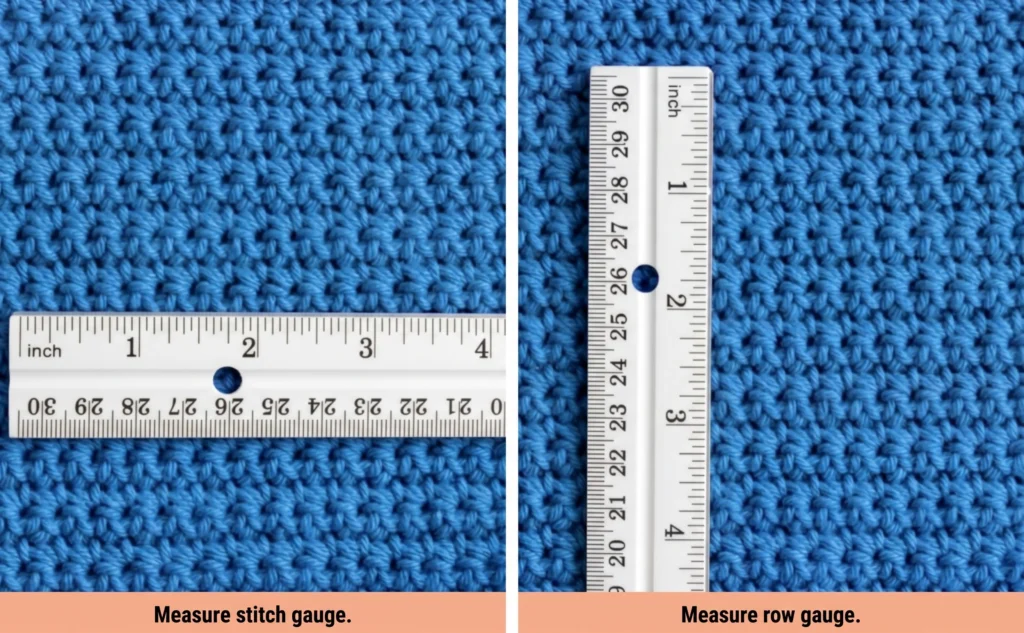
Write down both counts, the hook's millimeter size, the yarn, and whether the sample was washed or blocked. These notes make a second swatch useful instead of forcing you to remember what changed.
What to do when your gauge is off
Compare the stitch count first. If it differs from the pattern, change only the hook size for your next sample so you can see whether that one change moves the fabric in the right direction.
More stitches than the pattern calls for within 4 inches means your stitches are too small. Try a larger hook, then make and measure a fresh swatch using the same yarn and stitch pattern.
Fewer stitches within 4 inches means your stitches are too large. Try a smaller hook and repeat the sample; avoid pulling the working yarn tighter just for the test, because that may not be how you crochet the whole project.
Once stitch gauge matches, check row gauge again. A hook change can affect both measurements, but the two counts do not always move together. Record the new numbers before deciding on another adjustment.
If stitch gauge matches and row gauge does not, read the pattern's construction notes. You may be able to work a section to a measured length, while shaping placed on particular rows needs closer attention; ask the pattern designer before changing a shaped section.
If the result seems inconsistent, check the easy causes before making a third swatch: the stitch used, the number of chains counted as stitches, the ruler's starting point, and whether one sample was blocked while the other was not.


Variables to keep consistent
Yarn thickness, fiber, and texture affect how stitches sit together. Changing yarn can change both gauge and drape, so a hook adjustment that fixes the count is useful only if you also like the fabric it produces.
Use the same hook model for swatching and making the project when possible. Hooks with the same stated millimeter size can feel different in the hand, and that difference may change how you work.
Check the width of a growing project from time to time, especially after a long break or a change of yarn lot. If it drifts from the swatch, measure the fabric again before continuing many more rows.
Crochet gauge questions
Do I need a swatch for every project?
Make one when size, fit, or yarn use is important. For a flexible practice square, you may choose to skip it; for a fitted sweater or a set of equal-size motifs, the sample is time well spent.
Can I count over 2 inches instead of 4?
A shorter span magnifies small counting errors. Measure over the full distance in the pattern when you can; if a small motif makes that impossible, use the motif measurement the designer provides.
Should I measure before or after blocking?
Use the state specified by the pattern. When no state is given and you expect to wash or block the finished project, measure after treating and drying the swatch in the same way.
What if my stitch gauge changes after washing?
Use the washed measurement to judge the expected finished size, and keep the before-washing number in your notes. It can help you check the project while it is still on the hook.
Can I use a foundation row for the sample?
Use it if the pattern uses one and allows it in the gauge instructions. Otherwise, start the sample the way the main fabric begins so your test resembles the project.
Does a turning chain count as a stitch?
Follow the pattern's rule. A chain counted as a stitch changes where the first and last counted stitches fall, so a different convention can make an otherwise careful gauge count look wrong.
Could I switch pattern sizes instead of matching gauge?
Do the measurements before making that choice. Another size changes more than width: lengths, shaping, and proportions may shift too. Matching the designer's gauge is the safer starting point for fitted work.
Start the project with your measurements
Keep the swatch and its notes beside the pattern. The target is a fabric that reaches the pattern's measurements and still has the feel you want, not an arbitrary loyalty to the hook size on the supply list.
If you are still getting comfortable with counting stitches, try the beginner crochet practice square first. Then return to this guide and measure a swatch made in the stitch pattern for your next project.
What’s Next?
Pin this post: Save this tutorial to your Pinterest boards so that you can come back to it later.
Leave a comment: We love to hear your feedback. Tell me in the comments below!
Share on Instagram or Facebook: When you make this project, share it on social media and tag me @iheartdiybystacy. We love to see what you make!
Have questions? Join the Facebook Group!
We hope this article was useful for you! If you have any additional questions, feel free to join my Facebook Group. We created this group for you to share pictures, ask questions, and help each other out.
I hope this article was useful for you! If you have any additional questions, feel free to join my Facebook Group.
Join the group to share pictures, ask questions, and help each other out.

Have a question? Use the form above to submit your question or comment.
I love hearing from you and seeing what you made!